book review

THE HORSE WHISPER and Thoughts on Struggles in Life

By | Book Review, Movie review | 2 Comments

Recently I read THE HORSE WHISPER a best selling novel by Nicholas Evans. In 1998 it was made into a movie, which Robert Redford directed and starred in. The story is about Grace Maclean a thirteen-year-old girl whose life is shattered by a terrible accident. One snowy day in upstate New York Grace goes horseback riding with her friend Judith. As they start up a hill Judith’s horse slips on ice and crashes into Grace’s horse Pilgrim. Judith falls off her horse and is dragged down the hill. Both girls and their horses end up in the road to find a semitruck barreling toward them.
The story is about Grace’s struggle back to health, physically and emotionally. Grace’s horse Pilgrim is also seriously injured and traumatized by the accident. He has become wild and uncontrollable. The veterinarian recommends putting Pilgrim down. Annie, Grace’s workaholic mother, refuses because she realizes her daughter’s full recovery is connected somehow to Pilgrim’s recovery.
In Annie’s search to find help for Pilgrim, she hears about Tom Brooker, a man with unusual abilities with horses called a “horse whisperer.” When Tom sees the terrible shape Pilgrim is in, he says it’s too late to save the animal. Annie refuses to take no for an answer and drags her daughter and the horse all the way from New York to Montana to beg Tom to work with the horse.
Annie and Grace have a dysfunctional relationship and Grace refuses to talk to her mother on the drive west. The book is about the struggle of the daughter and horse to recover from the accident and the struggle of the mother and daughter to rebuild their relationship.
The story is also about Annie taking a new look at her life and what is truly important. She and Tom fall in a love and have an affair, which leads to further complications.
The majority of the movie portrays the book fairly accurately, but if you really want to find out how the horse whisperer works with horses I’d recommend reading the book. The movie also softens the affair to a romantic dance and changes the end to a happier one.
The book and movie were both inspired by Buck Brannaman, a man with an amazing, almost spiritual way with horses. A documentary named BUCK was made about him. The film won the Roger Ebert’s list of the Best Documentaries of 2011 and the Oscar shortlist. Buck said he doesn’t help people with horse problems but rather horses with people problems. His compassion for horses came partly out of a challenging childhood with a violent father.

No one likes hardship and suffering, but it is through the trials of life that some of greatest learning comes. It reminds me of the story about a man who found the cocoon of an emperor moth. He watched the moth struggle to come out of the narrow opening of the cocoon and decided to help it by cutting off a bit of the top. The moth emerged with a swollen body and small wings, and died soon after. The man wondered what had gone wrong. He looked up information about the emperor moth and discovered that in order for a pupa to become a moth, it must squeeze its way out of the narrow neck of the cocoon. This forces the fluid out of the body and into the wings so it will be able to fly. The man thought he was being kind by cutting a slit in the cocoon and easing the moth’s journey. Instead the poor creature was never able to reach its full potential and become a beautiful emperor moth.
In THE HORSE WHISPERER the child, mother and horse all have to go through a great struggle like the emperor moth. Through their experience they grew and emerged as stronger more loving beings.
All of us have struggles and challenges in life to help us learn love and compassion. Through our hardships we develop beauty and grace as the emperor moth does as it emerges from its cocoon.
Have you had an experience where you were faced with a challenge and rose to the challenge to become a stronger, more compassionate person? Please share your experiences.

share this:
Facebooktwitterpinterestlinkedin

Atlantian Records Starfall by Cieladora

By | Book Review | 2 Comments


Is it possible that the Atlantean people kept detailed records of their lives and today some people have the ability to access those records? Author Cieladora believes this is so and has written about it. The story behind her book is intriguing.
One night Cieladora awoke and heard whispering. “The hushed voice spoke in oddly accented English punctuated with bird chirps, twitters, and clicks.” (p.iii)
Through the night the voice gave an eyewitness account of the last days of ancient Atlantis. The next night Cieladora again dreamed about the fall of Atlantis. “The dream was like a hologram of history played on a 3-D news channel.” (p. vi) When she awoke, Cieladora went to work and forgot the whole dream.
Two weeks later she spoke to her psychic friend Marie and a surge of memories from the dream came back. Marie immediately recognized the significance of the dream and urged Cieladora to write down notes about the story. Cieladora wrote as much as she could recall about the five days leading up to the destruction of the Second Atlantean Empire. This is the basic premise of her book, Atlantian Records Starfall: The Fall of the Second Atlantian Empire.
This story is told through four different people of the time: Teohi, a Matrix Master; Xoio, a Regent of the Atl’lactoi Settlement in North America; Potemki, a man who is the outcome of Xoio’s genetic engineering; and Triatl, a free man who was a native of South America.
During the time I was reading this book, my husband and I attended a New-Age Exposition. As I walked through the exhibits I saw the book Atlantian Records Starfall on one of the tables. The woman at the booth was Marie, Cieladora’s psychic friend who encouraged her to write the book. Marie explained in more detail about life in Atlantis and invited me to a workshop she was doing on the book.
A month earlier Harold Klemp, the spiritual leader of Eckankar, mentioned a book called Atlantis in the Amazon by Richard Wingate. Klemp said many people living today lived in Atlantis previously and that learning about Atlantis could help us understand our dreams. A few days before attending the Expo, I dreamed I was in a city and a wall of water rushed toward me and those I was with. We ran into a building that was a place of healing. When I awoke, I wondered if the dream was a past-life memory of Altantis.

I’d first heard about Atlantian Records: Starfall from a friend of my husband while attending a lecture by Frank Joseph. Joseph also wrote a book called The Destruction of Atlantis. In his book Joseph links the worldwide cultural phenomenon to the story of the lost Atlantean civilization that disappeared into the sea in a violent cataclysm.
Joseph provides compelling evidence from around the world that Atlantis existed based on archaeology, geology, astronomy and ancient lore, whereas Cieladora’s book looks into what it was actually like to live on this remarkable island. Her book shows the homes, ships, culture and technological advances of the age.

She also explains that originally Atlantians came from another planet where people had psychic abilities and were exceptionally tall. When building Atlantis, they set up a lattice (energy grid) called The Matrix Energy, which provided energy for cooking foods, lighting buildings and heating and cooling homes. “The Matrix Energy that powered the Atlantian Empire was a form of psychic energy generated by the minds of thousand of trained Matrix Workers.” (p. vii)
If you wonder if Atlantis existed, you might want to read Joseph’s book. If you want to read about life on Atlantis, I’d recommend Cieladora’s book. It’s fascinating to me that some people have the ability to tap into the records of Atlantis.
I attended Marie’s workshop on Atlantian Records: Starfall and met another woman who was able to hear these ancient Atlantean recordings. I wonder if there’s a reason the Atlanteans are contacting us now. Perhaps it is a warning since our country is making some of the same mistakes the ancient Atlanteans did. We can learn much by studying these people from the past.
What ancient cultures have you tapped into associated with your past lifetimes? Let us know if you’ve had similar dreams!

share this:
Facebooktwitterpinterestlinkedin

Joan Grant: Author of Winged Pharaoh

By | Book Review, Past lives | 21 Comments

Recently I went to the “King Tutankhamun and the Golden Age of the Pharaohs” exhibit at the Science Museum of Minnesota.  The beautiful wall designs, jewelry, statues and architecture of ancient Egyptian civilization (which lasted for 3,000 years—from 3050 BC to 337 AD) fascinated me and rekindled my interest in that time period.

Ancient Egypt has been studied for centuries but it wasn’t until 1799 AD (after the Rosetta Stone was found) that modern man had the key to understanding Egyptian hieroglyphs. The decree on the stone occurred in three scripts: Egyptian hieroglyphs, demotic script and Ancient Greek. This enabled scholars to decipher it. The Egyptian hieroglyphs gave us a glimpse into their culture.

We learned much from the tombs, ancient runes and temples, but it’s hard to imagine what it was actually like to live back then.  What did the people believe, how did they live and what was important to them?

While I was wandering through the museum, my thoughts turned to Joan Grant who wrote three books about her past lives in ancient Egypt.  Her first and most famous book, Winged Pharaoh, was published in 1937.  Grant shot to fame upon its publication and it is still considered a classic. The New York Times hailed it as “a book of fine idealism, deep compassion and a spiritual quality pure and bright as flame.”

Joan went on to write a series of “historical” books.  It wasn’t until almost twenty years later that Joan claimed to recall the events in the books while in a trancelike state and that the episodes were of her own past lives.  Winged Pharaoh is about Sekhet-a-ra, the daughter of a Pharaoh, who with her brother (Neyah) becomes co-ruler of Kam (Egypt).  As a young woman she is sent to study at a temple to become a “winged-pharaoh”—a ruler and priest because of her clairvoyant powers.  Her initiation into the inner mysteries includes a four-day ordeal where she is enclosed in a tomblike place and her spirit leaves her earth-body in search of wisdom.  It is in this place that initiates die (to an old state of consciousness) and are born again in wisdom.

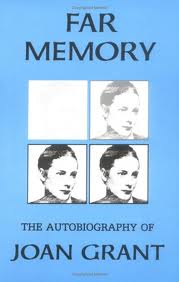
Far Memory: The Autobiography of Joan Grant was published in 1956.  It’s here that Joan tells about how she came to remember her past lives.  What soon becomes clear is that she learned her clairvoyant skills in her life as a priest in Egypt and those skills carried forward into her current life as Joan Grant.  One of her skills was what she called “psychometrise,” the ability to touch an object to get visions about the owner and its history.

Joan experimented with many objects, going into a trance and speaking of  her visions while her husband wrote down what she saw.  Once she used an ancient Egyptian scarab made of turquoise.  The scarab beetle symbolized the rising sun and constant renewal of life to the Egyptians and it was used as an amulet.  Joan wrote of this experience: “The moment it touched my forehead I know it was warm and lively.” (p. 253 Winged Pharaoh)

By touching the scarab, Joan had visions from Sekhet-a-ra’s ordeal of initiation.  Fascinated by what she learned about Sekeeta, Joan continued to use the scarab to gain visions day after day.  Eventually she realized that she was remembering her past life as Sekeeta and she didn’t need to touch the scarab to have visions.  Sometimes she watched the scenes while at other times she seemed to be experiencing them.  The scenes from this past life were in random order. Gradually Joan put them into chronological sequence from when she was a baby to when she died.

As a child Sekhet-a-ra traveled out of her earth-body to other lands to learn about them.  Sekhet-a-ra’s mother tells her: “All upon Earth are travelling toward their freedom and must one day reach the great gate where the last shackle is struck from their feet.  Then shall all be equal in the light of the last sunset and the first sunrise.” (p. 77 Winged Pharaoh)

Sekhet-a-ra looked at death as a joyful occasion of returning home.  At the end of her life she says, “Far below me I saw Earth as a little cold room that had opened its doors and let me free.  .  .  . Then like a sun-shaft breaking through a cloud I left the shadow-land of tears and pain, to walk with my dear companions in the Light.” (P. 322- 323 Winged Pharaoh)

Joan Grant’s current life was just as fascinating as her past life as a pharaoh.  She was born in 1907 in London, England and describes her resentment at being trapped in a baby body.  When she was a child she saw a “monk” ghost in the music room of her home, “Seacourt ” shown in the photo, and tried to get rid of it.

The First World War broke out when she was ten and she started having dreams of being on a battlefield as an adult in a Red Cross nurse uniform or as a stretcher-bearer.  She was frightened by these “nightmares” and too young to understand that she was tuning into soldiers who were fighting in the war.  In her war “dream” experiences she had to report to duty and get orders.  Sometimes she explained to a soldier that he had been killed and was dead or she had to encourage a seriously wounded soldier to return to his body as he wasn’t due to die.  In these experiences she got close to people and could feel and see what they felt and saw.

As a young adult Joan dreamed of a man for a year before she met him in her “earth” life.  When they met they both recognized the other from their dreams. They were already deeply in love with each other.

After reading Winged Pharaoh, it was clear that Joan learned clairvoyant skills and some ways to help people inwardly in her life as an Egyptian priest.

She carried these skills over into her life as Joan, even when she was still a child.  As Joan grew older she was able to bring back more of her skills and continued to help others.

Winged Pharaoh is a beautifully told story that gives a detailed picture of life in ancient Egypt from the point of view of a person who lived back then.   It gives details about the dangers of lions, crocodiles and poisonous snakes, the climate, what people ate and wore, as well as insights about their religion and how they were governed.  Reading Winged Pharaoh made the King Tut exhibit come alive to me on a whole new level.

share this:
Facebooktwitterpinterestlinkedin

Carol Bowman Children’s Past Lives

By | Book Review, Past lives | 25 Comments

Some parents and preschool teachers have noticed that young children will occasionally talk about another lifetime.  It’s as if the veil between their last life isn’t fully drawn. The glimpses these children get into the past allows them to remember a small piece of another life.  At other times they’ll remember their most recent past life in vivid detail.  The child may startle their parents by saying something like, “When I was big . . .” or “When I used to be a nurse or fireman . . . .”

At other times they have nightmares or fears connected to their past lives.  My niece would wake up crying at night.  In a past life her family died in a fire while she slept overnight at a friend’s house.

In Children’s Past Lives: How Past Life Memories Affect Your Child Carol Bowman researched different studies on children who remember past lives.  She takes the field of healing from past lives a step further by teaching parents how to help their child get over phobias from another life.

Bowman’s journey into this study began when her young son Chase suddenly became afraid of fireworks.  Soon after, a hypnotherapist friend of hers, Norman Inge, came for a visit and Bowman mentioned her son’s fears. In an impromptu therapy session, Inge asked Chase what caused his fear of loud noises.  Chase began to describe himself as a soldier carrying a gun with a sword on the end of it in the midst of battle, surrounded by smoke and flames. Eventually, he was wounded.  Unlike adults, Chase didn’t needed hypnotic induction to remember his former life.  After recalling his life as a soldier, Chase’s chronic eczema and phobia of loud noises went away.  Later Chase remembered more about this fateful day in battle.

After his wound was patched up, he was sent back to the battlefield to operate the cannon and was killed.  He floated above the battle, glad he was done with that hard life.  Then he floated over his house and said good-bye to his wife and children.  “They don’t see me because I’m in spirit, but they know that I’m dead.” (p. 24)

Bowman previously had a memory of a past life when she was very ill in this lifetime.  Like her son, the remembrance helped her heal.  In the experience Bowman states the following:

“I understood—really understood—that I was a part of something greater than the finite me.  In a flash I realized that this energy I felt within myself could never be destroy—it would always exit.  Only the body dies, while this essence that was everywhere but somehow still centered in my body continues forever.”  (p. 34)

Bowman wondered why she was healed and came to understand that it had something to do with “recognizing patterns from the past and understanding how they carried over from life to life.” (p. 48)

Bowman’s inner question about what reincarnation meant for her present life was finally answered—directly and practically.  “Re-experiencing my past lives released the grip of the past and gave me a fresh start in the present.” (p. 49)

Her interest in Chase’s experience led her to do extensive research on reincarnation.  She found books by Dr. Edith Fiore, Dr. Helen Wambach and Dr. Raymond Moody.  Wambach did experiments to prove past lives are real after having a spontaneous past-life recall.  Wambach hinted that “The healing effect of recalling past lives is both powerful and universal.  Just by remembering past lives, people could heal themselves of phobias.  They didn’t even have to know it was possible.” (p. 64)

Fiore’s book You Have Been Here Before focuses on the healing benefits of past-life regression.  She discovered an emotionally traumatic death is often the cause of the patient’s problems.  Once the forgotten trauma surfaces, the patient’s symptoms begin to clear up.

In Dr. Raymond Moody’s book Life After Life, he describes near-death experiences similar to Dr. Fiore’s reports of patient’s descriptions of their death experiences during regression.

“Everyone who remembered dying described a continuation of consciousness after death; their awareness didn’t cease when their heart stopped beating.  Their perceptions remained viable.  They could see, hear, sense what was happening to them and around them . . .

“At the moment of death, they felt themselves leaving their bodies, suddenly feeling lighter, floating like a feather, rising up into the air, looking down at the scenes they had left below. . . . Many entered a celestial realm of bright light and bathed in its warm, loving presence.” (p. 68)

Bowman’s study led her to Dr. Ian Stevenson who wrote Twenty Suggestive Cases of Reincarnation and Children Who Remember Previous Lives: A Question of Reincarnation.  The first book is full of cases where two- or three-year-old children recall, without prompting, enough details of a past life for his or her former identity to be established.  Bowman realized that Stevenson was addressing the question:

“What survives bodily death? Thanks to his enormous lifelong effort, for the first time in the history of science we have objective evidence for proof of reincarnation—evidence that suggests strongly that something of our personality does survive bodily death.” (p. 110)

For thirty-five years Dr. Stevenson and his colleagues collected 2,600 cases in a range of culture and religions from around the world. (p. 112)


Bowman pursued training to do past-life regressions and began her work with children.  Once when regressing her son Chase, she asked him “What happens after we die?”  He explained:

“You can go back to a scene from the life you left and get any information you want to answer questions to finish up your life there.  You can see what happens with the people you left behind.  You can go back while you’re in spirit and say good-bye and see what happens to them in the future.  If you see that all is well with them, this frees you to leave the Earth plane.” (p. 139)

Bowman decided to write a book on children’s past-life memories, so she placed an ad in a parenting magazine asking parents to share their children’s past-life memories. Colleen Hocken answered her ad.

Colleen’s three-year-old son remembered being hit by a truck and killed.  This past-life memory was confusing because he couldn’t differentiate that life from his current one.  Bowman gave Colleen techniques she could use to work with her son to “clarify” the painful events that happened in his past life.  He needed to understand his current parents loved him and that he was hit by a truck while in another body. After having a conversation with his mother about his past life, the child’s face lit up. “You could just feel this incredible weight lift off him.” (p. 174) Colleen told Bowman. He became a happy, playful child again.

Colleen went on to say, “‘More people need to know that children can have troubling past-life memories and that their parents can help.’ She added, ‘I’m going to write to Oprah Winfrey to tell her about this.’” (p. 175)

This resulted in Bowman, her two children and Colleen Hocken appearing on Oprah to talk about past-life memories.  People in the audience also shared some past-life memories from childhood.  One woman shared the following (excerpted from Bowman’s book):

“When she was a little girl, she heard a single plane fly overhead, but had a vision of the sky filled with squadrons of planes coming to attack.  She ran to her grandfather, screaming, “Run to the cellar, the bombers are coming!”  (p. 187)

This story brought back my memories.  Many times I’ll be peacefully gardening and hear a plane fly overhead. Instantly I have an urge to run into the house and hide in the basement.  I suspect this stems from my own past life in World War II.

Bowman also shared her upset and unhappiness as a child at being sent away to camp.  Upon further exploration, she discovered that her feelings came from her last life when she died in a concentration camp.  This also lit up for me; when I was a child I had the same unexplained upset at being sent to camp.

Bowman states the following:

“Any child, anywhere in the world, can have a past-life memory, regardless of the cultural or religious beliefs of the parents.  Most of those memories don’t cause problems.  They are benign and are useful to help explain a child’s talents, temperament, behavioral quirks . . . they can forever change the most fundamental beliefs of the parents about death and life.  For, by sharing their memories with us, small children teach what we adult have forgotten: that life continues after death.

“Sometimes, though, children have troubling memories from the past that create problems, such as phobias or physical ailments.  These children may need help separating past from present—they may need to be told that the past life is over.  Or if the memory is a sign that something from the past is unfinished, they may need help discovering what that unfinished business is in order to resolve it.  They may need to examine their feelings and thoughts at the moment of death and be guided toward a resolution . . .

“For some children it’s even simpler than that . . .  all the parent needs to do is simply acknowledge the truth of the memory and not deny it. Then the memory will run its course.” (p. 152)

The second and third parts of Bowman’s book are A Practical Guide to Children’s Past-Life Memories and Listen to the Children.  These two sections give techniques parents can use to work with their children who have past-life memories.  In the last section, Bowman explores the reasons people are afraid to publicly come out and say they believe in past lives.  It may come from a past life where people were executed for having ideas outside church dogma.

If you have a child with a past-life memory you’d like more insight into or if you are fascinated by the topic, you’ll find Bowman’s book a well documented, thorough study that can transform your ideas about life after death.

Below is a You tube video interview with Carol Bowman

http://www.youtube.com/watch?v=k-MVcWEusW8

share this:
Facebooktwitterpinterestlinkedin

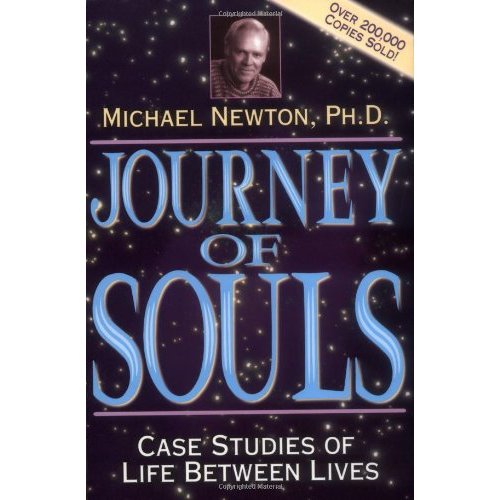
Michael Newton, Journey of Souls book Review

By | Book Review, Past lives | 5 Comments

Most of us have pondered the questions, “Why are we here?” and “What happens after we die?”  We wonder why some people are born to a wealthy and/or loving family and why others are born into poverty and/or into an unloving family.  We wonder why some people suffer from disease and die young while others live a long, healthy life.

We may come to conclusions based on our own personal religious beliefs or based on what we were taught in church.  Most think you can’t actually know the answers to these questions until you die.   Michael Newton’s book Journey of Souls Case Studies of Life Between Lives offers new insights into what happens between lives, why we are born, and why the physical world is such a hard place.

Dr. Michael Newton is a hypnotherapist who discovered that we, as soul, have a life in the spirit worlds between our lives here on earth.   The first time he had a glimpse into this soul life was when he hypnotized a client and asked her why she was lonely.  She replied, “I miss some friends in my group and that’s why I get so lonely on Earth.”

Over a period of ten years Dr. Newton worked with his clients carefully recording what they told him about their life in their “life between lives”.  He discovered that helping people find their place in the spirit worlds was more meaningful to people than remembering former lives on earth.

Newton says, “Having a conscious knowledge of their soul life in the spirit world and a history of the physical existence on planets gives these people a strong sense of direction and energy for life.”  (P. )

This remarkable book covers soul’s experience right after the body dies, and the journey to its spirit-world group of friends and what it learns there.

Many books discuss reincarnation, but this is the only one I’ve run across that goes into depth about what soul does between lives.  One of the most important aspects of Newton’s finding is helping people to eliminate the fear of death.  Newton says at the time of death, “All people report a euphoric sense of freedom and brightness around them.  Some of my subjects see brilliant whiteness totally surrounding them at the moment of death, while others observe the brightness is farther away from an area of darker space through which they are being pulled.  This is often referred to as the tunnel effect, and has become well know with the pubic.” (p. 9)

After this tunnel effect, soul is met by their relatives, close friends, and/or personal guide.  More advanced soul isn’t met by anyone as they don’t require a support system.

Next, souls are taken to a “space of healing” to help soul recover from their last life.  Here soul is debriefed by their guide about the life that just ended.  Earth is a hard place compared to the love and wisdom of the place where soul was created, so soul often returns bruised and needs time to heal.

After healing, soul returns to its group of intimate old friends who are at about the same awareness level.  This is “a small primary unit of entities who have direct and frequent contact, such as we would see in a human family.” (p. 8)

A guide, who is a more advanced soul, works with the group. “Guides only want the best for us and sometimes this means they must watch us endure much pain to reach a certain objective.  Guides cannot assist in our progress until we are ready to make the necessary changes in order to take full advantage of life’s opportunities.”  (p. 119)

With their group a soul will go over their last lifetime and review what they did well and what they could have done better.

Souls are on different levels: beginner, intermediate and advanced souls.  Newton didn’t interview many advanced souls.  He says, “The fact is, a person whose maturity is this high doesn’t seek out a regression therapist to resolve life-plan conflicts.” (p. 16)

An advance spirit shows more patience with society and has good coping skills.   They show kindness and understanding towards others.

The next area Newton covers is the selection of soul’s next life.  After the wounds of a past life are healed, soul feels the pull to reincarnate again on earth, though soul can reincarnate on other worlds a well.  With their guide, soul decides where they want to live, what lessons they want to learn, and what parents they want to be born to.

Newton gave an example of a soul who wanted to study music.  The soul wanted to live in New York with parents who were supportive and well off enough to pay for music lessons.  This soul said, “If I want to express the beauty of music and give pleasure to myself and others, I need proper training and supportive parents, otherwise I’ll get sidetracked.”  (p. 21)

Each person comes into a new life with lessons they have chosen to learn.  They pick a family, friends and a mate to help them learn these lessons.  One particularly interesting part of this plan is that we have triggers to help us remember the important people we will encounter in our life such as who we are suppose to marry.  A piece of jewelry, a laugh, the eyes, or a fragrance can trigger the memory.

We have amnesia about our soul identity when the soul and human brain merge. The merging takes place in the womb early or late in the pregnancy. This amnesia allows soul to have a fresh start.  But there is often a bleed through in young children who remember their past lives or in all of us when we meet someone we have an instant recognition of.

Once soul enters the body of a baby, it comes and goes while the baby is in the womb.  After birth, soul continues to come and go when the body is sleeping or in deep meditation.

In conclusion, Newton says, “If you carry away nothing except the idea you may have a permanent identity worth finding, I will have accomplished a great deal.”  (p. 274)

We live in an imperfect world by design.  “We bear responsibility in the evolution of a higher consciousness for ourselves and others in life.” (p. 276)  We learn that we have a loving place waiting for us where we belong.  One day we will go there to finish this long journey and reach a state of enlightenment.

I’ve just touched on the essence of this fascinating book. You may not agree with all of Newton’s findings, but does open doors to possibilities.  I believe he has just scratched the surface of the inner worlds and there is much beyond what he describes.

Michael Newton has written other books and has some You Tubes videos online.  Here’s one you might find interesting.

share this:
Facebooktwitterpinterestlinkedin

Brian Weiss on Past Lives

By | Book Review, Past lives | No Comments

Last winter when I visited friends in Hawaii, I came across a remarkable book on their bookshelf: Many Lives Many Masters by Brian Weiss.  It is a true story about a prominent psychiatrist and his patient who were both changed by the patient’s past-life memories. I recommend this book to anyone who is interested metaphysics.  It is a thought-provoking, fascinating story that took courage to write.

Catherine came to see Dr. Weiss because she was plagued by fears, phobias and anxieties that were keeping her from living a happy, fulfilled life.  After 18 months Dr. Weiss had still not made any significant progress treating her, so he tried regressing her to her childhood through hypnosis.  She remembered some childhood trauma, but she didn’t get any better.  So Dr. Weiss told her to go back to the time when her symptoms arose and she began telling him in great detail about a past life.

Neither Catherine or Dr. Weiss believed in reincarnation.  Weiss was skeptical at first but as Catherine continued to remember past lives his doubts eroded. Catherine’s past-life recalls occurred in many time periods and she was both male and female.  In all of them, she was an ordinary person: a servant, soldier or peasant.  Many of her lives were hard and her deaths brutal, such as having her throat cut or drowning in a flood.  However, it was remarkable that as she remembered these lives she started healing from her fears and anxieties.

Dr. Weiss began to research past lives and learned about Ian Stevenson who interviewed 2,000 children with past-life recall.  Weiss also discovered references to past lives in the Old and New Testaments that were taken out in 325 A. D. by the Roman emperor Constantine the Great.  Still it took him awhile to fully embrace the idea of past lives.  He studied them as a scientist would, and kept detailed records of his sessions with Catherine.

Interestingly in one session Catherine told Weiss that he was her uncle and teacher in 1568 B.C.  It became apparent that it wasn’t an accident that she and Weiss came together in this life.

In each lifetime, Weiss would take her to the moment of death and she would float out of her body, toward a light where guides or spiritual masters were always waiting for her. Even though her deaths experiences were similar,  her religious beliefs about the afterlife were different in each lifetime.

As well as remembering past lives, Catherine began to talk about her in-between–lives state.  In that state Catherine could channel guides or masters who spoke to Weiss.  Once they gave her a message from Weiss’s father and son, both of who had died.  The son had died as an infant from a heart defect and had come to show Dr. Weiss “that medicine could only go so far, that its scope is limited.” (p. 55)

From these inner guides Weiss learned that “we are all in school… (and) No one is greater than another.” (p. 210)  We learn a “systematic body of spiritual knowledge.  This knowledge spoke of love and hope, faith, and charity.” (p. 172)

From these past-life memories, Catherine got rid of her symptoms and became a much happier person. Meanwhile Weiss had a spiritual awakening and eventually felt guided to write this book about what he’d learned.  He thought it would comfort people to know that we never die, that we have lived countess life times, and there are spirits that are guiding us.

Dr. Weiss has written many other books about his experiences with patients remembering past lives.  You can check out his website at: http://www.brianweiss.com.

I also found an interesting You Tube video interview with Dr. Weiss Entreparentesis – Dr. Brian Weiss.

In this You Tube Weiss explains that consciousness survives death and that everything is about love.  In each life we have to come back here to get it right, but eventually we move to a higher place.

Knowing that our loved ones never really die helps people find joy.  In one of his past lives Dr. Weiss was killed for talking about past lives.  But in this life he feels incredibly blessed to be able to share this information and in return he meets wonderful people all over this planet.

share this:
Facebooktwitterpinterestlinkedin

Chungliang Al Huang

By | Book Review | 4 Comments

In a recent post I wrote about Huang being an inspiration to me.  Today, I found an article with a photo of  him in the Your Life Lakeshore Weekly News here in Minnetonka, Minnesota.  The photo was taken by Mark Trockman.

In the photo Huang demonstrates the Tai Jai move The Sing Whip in front of a new sculpture at the Marsh. The sculpture was done by Zhu Ming a Chinese artist and brought here from Hong Kong.

The photo captures the wonderful spirit of this amazing person.

Who are some of the people in your life who inspire you, help you follow your dreams and keep your vision on what is important to you?

share this:
Facebooktwitterpinterestlinkedin

Conscious Women Conscious Relationships

By | Book Review, Writing | 5 Comments

Darlene Montgomery has a new book in her conscious women series:

Conscious Women Conscious Relationships

True Stories of Wisdom and Awareness on the Path of Relationships.

Compiled by Darlene Montgomery

I have a story in the book called Three Gold Coins about my journey as a writer. In the story I talk about getting the story idea for my first book through a series of six dreams that were like watching an action/adventure movie.  I also talk about the amazing experiences that happen when I listened to my inner guidance while promoting Red Willow’s Quest.

The following is a quote from my story.

“We each come into this life with unique gifts and talents. It’s up to us to discover what they are, to develop and believe in them, despite the obstacles. We are always being guided and aided in our mission, if we listen and stay tuned to the highest part of ourselves. When we follow our heart and serve our purpose it opens the door for great joy and brings a passion for living to our lives. Equally important, it inspires others to do the same.”

The book includes a story by Oprah Winfrey called On Success.   Other stories are by Jo Leonard author of The Would Be Saint, Darlene Montogomery author of the Dream Yourself Awake, Ellie Braun-Haley author of A Little Door, A Little Light, and Monique Rider founder of Body Life Dynamics

Here is a quote from the introduction to the book by Darlene Montgomery.

‘”Nothing in our lives challenges us, sculpts us, nor moves us to grow or reflect the way our relationships do. Relationships of all kinds, from: spouses, parents, children, friends, relatives, workmates and more are the soil from which we harvest the qualities of patience, humility, harmony, detachment and most importantly, Divine Love. All of our relationships are for one thing: Ultimately they lead us to a greater relationship with our self and ultimately God.

All the stories in this book bear a lesson. Among them: forgiveness, letting go, humility and discipline. But above all these is the lesson of Divine Love. By using Divine Love in all life situations, we naturally learn its by-products of forgiveness, harmony and patience.”

Do you have a story about a lesson you learned from life and your relations?  Please share it as a comment so others can learn benefit from what you learned?

What People Are Saying About

Conscious Women Conscious Relationships

“Conscious Women, Conscious Relationships combines wise journeys of women’s struggles and joys with transcendent poetic images. The spiritual truths in these stories shine divine light onto the murkiest paths. Let these women inspire you to create your own conscious life.”

~Linda Anderson, co-founder, Angel Animals Network, www.angelanimals.com

“This is a book I have waited for my whole life. The stories are our own. Dare to find yourself in these pages!”

~Maxine Hyndman, Author, The Naked Millionaire and The Organic Entrepreneur

“The Conscious Women series of books is like a hug during uncertain times. It’s healthy and helpful for us to look at other women’s lives, their struggles and their triumphs. It helps us realize that—to paraphrase someone wiser than I am—no matter what lies ahead of us, it can’t possibly measure up to what lies within us. Here’s to conscious living—and Conscious Women! ”

~Erin Davis, Radio Host, CHFI

share this:
Facebooktwitterpinterestlinkedin