Today I want to share a poem by E. Johannes Soltermann who is a talented writer, poet and musician. One of the things he likes to do is play the piano at the Minneapolis/St. Paul airport to share his music and love of life. He is the author of The Gate: A Tale for the 21st Century, and Healing From Terrorism, Fear, and Global War.
Today I was at a meeting for a non-profit organization that distributes money to Minnesota charities. A woman named Jennifer sat at our table and she said, “In the US, one out of every four people has a criminal record.” In Minnesota, my home state, the statistic is slightly better: one in five.
Many crimes are committed by teenagers and are related to drug use or theft (such as stealing a bike out of a garage or shoplifting). One thing I did not realize is that once there were laws that protected young people so that these indiscretions didn’t go on their record, but this is no longer the case in Minnesota if a youth commits a crime after he’s sixteen. This change has hurt many people’s chances for a successful future. Having a criminal record makes it difficult to get a job, a higher education (some colleges won’t accept people with a record), and rent an apartment.
I don’t normally write about social issues, but another statistic that caught my attention was that children of color make up 93% of all children in poverty in Minneapolis today. More than half of all American Indian, Asian, and Black children living in Minneapolis live in poverty. Jennifer said the reason many children live in poverty is because their father has a record and can’t get a job.
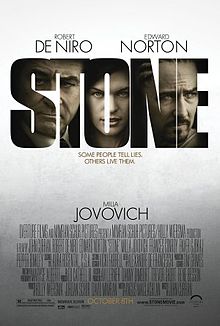
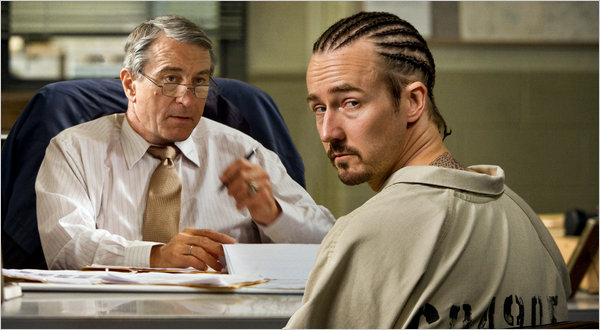
Learning about people with records reminded me of the movie STONE (2010). I don’t necessarily recommend the movie because it is a thriller with graphic violence and explicit sex. Yet it has excellent acting with Robert De Niro who plays the part of Jack, a seasoned Christian patrol officer near retirement and Edward Norton who plays Stone, a man eligible for early release for his crime of arson.
In a scene from the movie, Stone challenges Jack’s right to judge him and asks the question: When is the punishment enough? Stone asks Jack if he hasn’t ever done something bad. Jack replies he’s never committed a crime, but the viewer knows from the dramatic first scene in the movie that Jack did something shockingly wrong years earlier.
While Stone is in prison he comes across a brochure about Zukangor (a New Age religion, which is a take off on Eckankar). He is intrigued and goes to the library to find a book about it. He finds the religion teaches about the Light and Sound of God, karma and how to sing HU to uplift your state of consciousness. Stone tries singing HU in the noisy, challenging prison environment.
Gradually Stone begins to change. He sees a bigger purpose to life and feels it doesn’t matter if he stays in prison or gets out on parole. In either place he is getting the lessons he needs to grow. He starts to understand the crime he committed in a new light and realizes he never accepted responsibility for committing it.
Jack thinks Stone is just playing him with his new spiritual beliefs, but the viewer sees that Stone is beginning to change and grow. The viewer also sees that sometimes there’s a thin line between a person with a criminal record and those who judge him. There is so much more to this movie; I’m only covering one aspect of it (mainly to examine the question of who should be locked up and for how long).
When is the punishment enough? Once a person is released from prison how can they be helped to move forward with their life, get a job, a place to live and an education? It hurts not only the person who has the arrest record, but also their families when this record follows them throughout their life.
Do you think a young person’s mistakes should go on their record? I’d like to hear your viewpoint about this.
In the spring when the snow is still on the ground, my husband and I like to make maple syrup. This year spring was late, and we made maple syrup until the end of April.
There was a spring snow storm when we were tapping.
Frost on the trees.
First we drill holes in our maple trees, put a spigot in and hang bags. Then we dump the sap out of the bags into a stainless steel pan and boil it on an outside grill. Next we take the sap inside and cook it down more on a wood stove. It takes 30 to 40 gallons of sap to make one gallon of syrup. Our sap is higher in sugar content than most, so it takes less sap to make maple syrup.
“I have a story that will make you believe in God. This powerful statement made early on in the movie Life of Pi, is the one that sticks with me the most. The story that will make us believe in God is told by Pi, a middle-aged Indian man, to a writer looking for a good story.
You have probably heard of Life of Pi by now and many of you will have seen it. In the Academy Awards it was awarded best achievement in cinematography. It is an amazing feast for the eyes in 3-D. It’s also a film that leaves people thinking about its meaning long after seeing it. I had read the book (by Yann Martel) a few years ago and this is one of those few stories that is more powerful in film form. It has breathtaking scenes such as a school of dolphins, a whale leaping into the sky and amazing sunsets reflecting into the water. The film takes on a magical quality at times while at other times it deals with the savage brutality that can be brought out by people trying to survive in life and death situations.
The story within a story is about Pi (first time actor Suja Sharm) a sixteen-year-old youth who is in a shipwreck. He survives alone with Richard Parker, a 450-pound Bengal Tiger, on a lifeboat for 227 days. I don’t want to spoil the plot for those who haven’t seen the movie so I won’t go into all the metaphors, symbolism and layers that make up the story. The truth of the story like the truth of God is up to each of us to decide. What I will explore is the story’s spiritual side.
As Pi is telling the story of his childhood we find out he was the son of a zookeeper in India who believed in the New India and hard science. Whereas, Pi is a seeker who is born Hindu, comes to love Jesus and practices Islam. Each religion has its own myths, fables, rituals and customs and Pi sees their value and comes to realize the underlining essence of each religion is love.
When Pi is alone at sea with only a tiger for a companion his faith in God is severely tested. He has to endure the pain of losing his family and live with his fear of the tiger. His struggle for survival includes threats from sharks, starvation, dehydration, storms and loneliness. He’s forced to find a way to catch and kill fish to feed himself and Richard Parker even though normally he is a vegetarian.
A few scenes stood out for me as major spiritual turning points. In one, Pi yells out to God that he surrenders. What more does God want from him? I think all of us can relate to that feeling when we have been tested again and again until finally we let go and surrender to God. We know we are at life’s mercy and there is nothing more we can do. The agony Pi goes through leads him to find courage and inner strength.
Another pivotal scene is when Pi accepts that he is going to die with grace knowing he will rejoin his loved ones. In the scene he and the tiger are staving and dehydrated. The tiger has collapsed on the bench and Pi sits beside him and puts the nearly dead animal’s head on his lap. All along he has seen Richard Parker’s soul in his eyes and has come to love the tiger as a companion. He feels that the tiger has kept him alive as he has had to stay alert to keep from getting killed by the tiger and he needed to fish to keep both of them alive.
In another scene there is a violent storm at sea and Pi stands to face it while Richard Parker cowers under the tarpaulin, which covers half the boat. All at once the storm clouds open and light shines through. Pi feels the light is God is speaking to him. He unhooks the tarpaulin, so he can share the Light of God with Richard Parker.
The story asks many questions about the mysteries of life, such as why does tragedy happen, what is truth and what is our purpose here on earth? We all go through challenges and tests that seem more than we can endure and yet we are forced to use our creativity and become stronger for the experience. So perhaps in the end it does not matter if the story makes you believe in God, but whether it makes you think about life, love and God.
If you’ve seen the movie or read the book, share your comments. Did the story make you believe in God? Did it cause you to reflect on life? Were you different in some way after seeing the movie or reading the book in how you saw tragedy, hardship and courage?
A friend sent me a beautiful story that was on CBS News. It’s about Andy who had nine heart surgeries. The medicine he was taking made him feel so badly he stopped taking it. He always wanted to learn to play the harmonica so he took lessons. He was still around the next month so he bought hundreds of harmonicas for children and brought them to schools and taught the children to play. He’s still around eleven years later sharing music.
I wonder if the love he is giving out to children is what has kept him alive. He’s sharing music with his corner of the world.
Have you seem the foreign film Welcome directed by Philippe Lioret? At one point in the movie we see the image of a mat with the word “Welcome” at a neighbor’s front door, but the irony is that the French are anything but welcome to the illegal immigrants in their country.
This powerful movie is a parallel story about Simon (Vincent Lindon) a Frenchman who is going through a divorce and Bilal (Firat Ayverdi) an illegal immigrant. Seventeen-year-old Bilal is a Kurdish man who has walked for three months from Mosul, Iraq to France. Bilal comes to where Simon works at a public pool and asks him to teach him to swim. Simon works with him and comes to care about him like a son.
There is irony in this as well because Simon’s wife Marion (Audrey Dana) is leaving him partly because of his apparent indifference to the plight of the men who have illegally immigrated to France. Marion helps run an outdoor soup kitchen for illegal aliens who are struggling to survive. The immigrants want to get jobs so they can send money home to their families. We see them being turned away from grocery stores, from the pool (where they want to take a shower) and being arrested.
The story is set in Calais, the port in northern France closest to Britain. The cliffs of Dover are visible from Calais. As the story unfolds we find out Bilal wants to learn to swim so he can swim across the English Channel to the girl he loves. The youth spent three months traveling all the way from Iraq to France by foot and now has to get to England. He tries to get across the English Channel by getting aboard a ferry but after he gets caught by the police, he decides to learn to swim so he can swim across.
Simon’s heart opens (as does the viewer’s) to Bilal who loves a woman so much he walked 4000 km across several countries to get to her, and now is willing to swim across the English Channel. We also sympathize with Simon who says to his wife, “I couldn’t even walk across the road to get you back.” Simon still loves Marion and doesn’t know how to heal their marriage. Marion watches him help Bilal and realizes that Simon has begun to awaken to the plight of the illegal immigrants. She even worries for Simon who could be arrested and even incarcerated for helping Bilal.
I don’t want to give away the story, but rather focus on the topic of illegal immigrants. Where I live in Minneapolis we have illegal aliens from Mexico. When men get arrested, they get sent back even though the may be leaving a wife and children behind in Minnesota. It seems cruel to send them back. Yet our country is in a recession/depression and there aren’t enough jobs for our own people. Moreover, how can we afford to educate these children who don’t even speak English? How do we afford to pay for these people’s healthcare? Yet our country is based on immigration. We all immigrated here. Even the Native Americans immigrated here at one time.
Our country is the land of freedom and opportunity. At least that was what it was called when I was a child. We have benefitted from hard working immigrants. How do you feel about illegal immigrants? What is our responsibility to people from war-torn countries?
From time to time we are asked the question: “What if this was your last day?” Instead I was wondering: “What you would do if you knew you were going to live to be 100?” How would you live differently? Would you still retire at 62 or 65 or even 70? What interests would you pursue if you knew you had another 35 or 40 year to pursue them in after retirement? What ways would you contribute to the world during those 35 to 40 years?
Recently I was sent a delightful YouTube of 101-year-old Bel Kaufman. She said that retiring is like retiring from life and is quoted to have said, “I’m too busy to get old.” At 100 she taught a college class on Jewish humor at Hunter College. Even she seemed impressed by being asked to teach a class at her age. She still has a sharp mind and a great sense of humor, as you will see on this YouTube on fascinating elders.
Bel Kaufman was born in 1911 in Berlin, Germany where her father was studying medicine, but her native language was Russian. She was raised in Odessa and Kiev (present-day Republic of Ukraine) until she was twelve and her family immigrated to the US.
Bel is best know for having written a best selling 1965 novel Up the Down Staircase that was turned into a movie. The book was based on some of her experiences as a high school teacher. Her grandfather who wrote the stories that were developed into Fiddler on the Roof and who corresponded with other Russian authors such as Leo Tolstoy influenced her.
Here is a talk she gave at Iona College. It well worth listening to the YouTube. Bel talks about humor, her novel, and her experience of having her novel being made into a movie.
“What you would do if you knew you were going to live to be 100?” Did these YouTubes change your idea of what it is like to be old. I hesitate to say senior since Bel said being called a senior reminded her of senior prom.
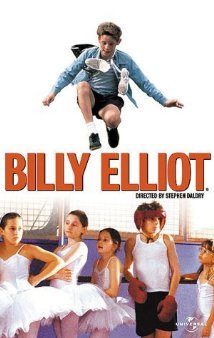
My husband and I spent the week before Christmas in court. A property we had a small ownership share of was sued. The jury didn’t rule in our favor, so on Friday night we decided to escape into the pleasure of watching a movie. The first movie we saw Cider House Rules (1999). After the movie was over I was still agitated over losing the lawsuit, so we watched Billie Elliot (2000).
Both movies explored the theme of rules and whether there are times when a person is justified in breaking them. Our experience in court also involved rules. During our law suit the judge decided many of the decisions in the courtroom like what evidence was admissible in court, and if one lawyer objected to a question the opposing lawyer asked, the judge sustained or overruled the objection. To some degree the judge influenced our losing the case. The plaintiff used the court system to extort money from the owners, and the judge seemed more interested in the rules than justice.
Cider House Rules explored right and wrong rules. The main character Homer Wells (Tobey Maguire) was raised in an orphanage. Dr Wilbur (Michael Caine) who worked at the orphanage took him under his wing and trained him as his assistant. Part of the doctor’s jobs was delivering unwed mother’s babies into the world. Sometimes the doctor performed illegal abortions. Homer helped with the births but didn’t approve of abortions and wouldn’t assist with them. Dr. Wilbur broke the law when he performed the abortions, but he did it to save the life of pregnant girls who might otherwise have an unsafe abortion.
Eventually, Homer decided he wanted to see the world and left the orphanage with an unmarried couple after the woman had an abortion. They invited him to work at a cider house. A traveling group of fruit pickers came each year to live in the cider house and pick apples. The house had a list of rules on the wall, but the migrant workers were illiterate. Homer was educated at the orphanage and read the first rule loud. The rule was to not smoke in bed, which one of the men happened to be doing. The head of the migrant workers told Homer to stop reading the rules as they didn’t apply to them.
The list of rules was only a symbol for the much more profound rules that Homer must decide if he would follow. He ended up breaking many rules some of which have profound consequences.
The second movie we watched was Billy Elliot (2000) set in 1984-1985 during a miner’s strike in Durham, England. Eleven-year-old Billy (Jamie Bell) was a miner’s son. Both his father and older brother work in the mine, which was on strike. Billy’s mother died and his senile grandmother lives with the family. Billy’s father paid for Billy to take boxing lessons, but Billy had no interest in boxing. When a ballet class started meeting in the same building as where Billy took boxing lessons, he found himself attracted to dance even though it’s an all-girl class. The teacher encouraged him to dance, but insisted that he pay. Billy skipped his boxing lessons and used his boxing money to pay for ballet dancing. Eventually his father found out and was horrified that his son was doing something as unmanly as ballet dancing and wouldn’t let him continue.
Meanwhile the whole town was on edge. The miners were picketing and the mining company had hired scabs. Billy’s older brother protested the scabs and got beaten up by the police and arrested.
The dance teacher believed in Billy and she started teaching him privately for free. She thought he had the talent to get a scholarship at the Royal Ballet School in London, and helped him develop a dance routine so he could audition.
Getting into the academy in London would not only be a chance for Billy to dance, but also a chance to break out of the bleak future of becoming a miner.
Billy broke his father’s rules when he used his boxing money for dancing lessons. Even after his father found out and forbid him to dance, Billy disobeyed his father and continued to take dance lessons because he loved dancing. He said dancing was like he had this fire in his body, flying like bird, like electricity.
Both of these outstanding movies had powerful stories and great characters. Billy Elliot also has fabulous dance sequences. Both movies caused me to think about rules long after I’d watched them. Rules are needed in a society by parents, teachers, governments, etc. and most should be obeyed. Yet some rules are bad ones or there are legitimate reasons for breaking them.
What rules have you broken in your life? When is it all right to break a rule and when is it wrong? I’d enjoy hearing your feedback.
A friend sent me a link to a Ted Talk about Ronny Edry, an Israeli graphic designer. In March of 2012 he shared a poster on Facebook of himself and his daughter with a message “Iranians we will never bomb your country. We love you.” Ronny said that the war between Israel and Iran has seemed imminent for the last decade and the people in Israel live in fear. He posted the poster on facebook and people both in Israel and Iran responded with positive comments. He made another poster with his wife and child, and then he made more posters of Israeli people with the same message. Ronny said that people see images and he wanted them to see that it wasn’t just one man with this message but many Israelis.
The people from Iran responded with their own posters that said, “Iranians we will never bomb your country. We love you.”
An Iranian girl said she’d been taught to hate the Israeli flag, but now she loved the the blue color and the star.
“Something happening,” Ronny said. “Good news.”
One of the people commenting on the Ted show said, “I believe these brothers and sisters have stopped a war by showing unconditional love for all. Let’s spread that around the world!!!”
It’s wonderful to see what one man can do to make the world a better place.
Here is a link to this inspiring show. It brought tears to my eyes; maybe it will move you as well.











Recent Comments